
Table of Contents
Understanding Vancouver Short-Term Rental Regulations
Navigating the rules for a short term rental Vancouver hosts must follow is essential before listing a property. Understanding Vancouver Short Term Rental regulations is crucial for hosts who want to operate legally and avoid penalties. The provincial government of British Columbia provides the overarching framework, requiring all short-term rental operators to register with the province. According to the Government of British Columbia, hosts must also secure a business licence in municipalities where they are required, ensuring compliance across all booking platforms including Airbnb and VRBO.
In Vancouver, the vancouver short term rental regulations are particularly specific. The city mandates that a short-term rental must be operated within the host’s principal residence, meaning the property where you live for the majority of the year. Additionally, a short term rental business licence vancouver authorities issue is mandatory for all hosts. We help our clients understand these foundational rules, though we always advise consulting official channels or a legal professional for specific compliance advice.
How Vancouver Regulates Short-Term Rentals
Vancouver enforces strict rules beyond provincial requirements for short-term rentals. For any Short Term Rental Vancouver BC host, understanding how the city regulates short-term rental in Vancouver is essential to maintaining a legal listing.
The Principal Residence Rule Explained
Vancouver permits short-term rentals only in the host’s principal residence — defined as the dwelling where they live at least six months per year and declare for tax purposes. According to the Government of British Columbia, this rule was implemented to preserve long-term rental housing stock for residents. A condo occupied most of the year qualifies for short-term rental in Vancouver; a basement suite rented separately does not. Understanding vancouver short term rental regulations is crucial, as investment properties and secondary homes remain ineligible under current city bylaws.
Recent Regulatory Changes (2025-2026)
The 2025-2026 period brought stricter enforcement and increased fines for non-compliant hosts. The city expanded audit capacity and introduced heavier penalties for unlicensed rentals and false declarations. Proposed zoning amendments may further refine rules, making it essential for hosts to stay informed through official channels.
Vancouver’s Short-Term Rental Rules Side-by-Side
The following table summarizes the key regulatory requirements hosts must navigate:
| Regulatory Aspect | Vancouver Requirement | Key Details |
|---|---|---|
| Principal Residence Requirement | Host must live in the rental unit as their primary residence | Only principal residences can be rented short-term. Secondary homes, investment properties, and second suites are generally not eligible. |
| Business Licence Requirement | License required for any short-term rental offered for less than 30 consecutive days | Annual licence with a fee. Application includes property details, proof of principal residence, and compliance with zoning and building codes. |
| Provincial Registration (BC Registry) | Must register the rental with the BC Government’s short-term rental registry | Registration is separate from the city licence. It involves creating an account and listing each unit. Non-compliance can result in penalties. |
| Strata Restrictions | Strata corporations can prohibit or restrict short-term rentals through bylaws | Even with a city licence and provincial registration, strata bylaws may ban rentals. Always check your strata’s rules. |
| Occupancy & Zoning | Maximum occupancy limits per rental unit | The rental must comply with building occupancy limits. Zoning regulations also apply regarding where short-term rentals are permitted. |
Compliance requires satisfying every regulatory layer — city licensing, provincial registration, and adherence to strata bylaws and occupancy limits. Obtaining a short term rental business licence in Vancouver is a mandatory first step, but it alone does not guarantee full compliance if provincial registration or strata restrictions are overlooked. Hosts should verify all requirements before listing on any platform.
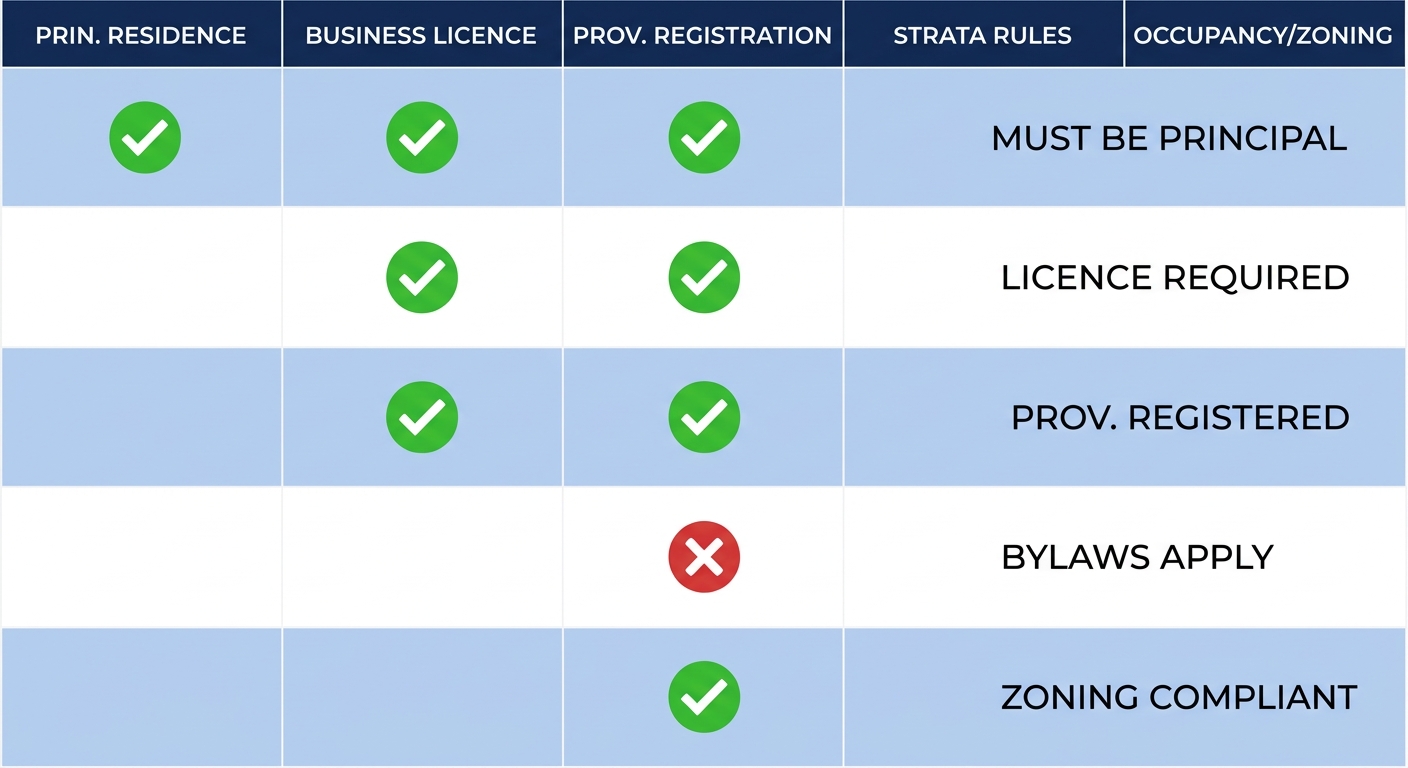
Comparison of Vancouver short-term rental regulations
With these rules in mind, the following section covers how to ensure your listing complies and avoid common pitfalls. This information is for general guidance only; consult a licensed professional for legal or tax advice. Georgia Properties provides consulting and marketing services, not property management.
Short-Term Rental Licensing and Registration in Vancouver
Operating a short term rental in Vancouver is an attractive opportunity for many homeowners, but it comes with strict compliance obligations. The City of Vancouver and the Province of British Columbia each have separate licensing and registration requirements that every host must meet before accepting their first booking. Understanding these regulations is critical to avoiding fines, maintaining good standing, and building a responsible hosting practice.
How to Apply for a Vancouver Short-Term Rental Business Licence
The first step to legally hosting a short term rental in Vancouver is to obtain a business licence from the City of Vancouver. Your unit must be your principal residence–investment properties and secondary homes generally do not qualify under current Vancouver short term rental regulations. Once you confirm eligibility, gather the required documents: valid government-issued photo ID (such as a BCID or driver’s licence), your current property tax notice, and a letter of authorization from your strata council if applicable. You will then need a BCeID to access the City’s online VanConnect portal, where the entire application is completed and submitted. Processing times vary, but the application is fully digital and designed to be straightforward.
Licence Cost and Fees in Vancouver
The short term rental business licence Vancouver hosts require involves an annual licence fee of approximately $109, plus a one-time application fee of about $52. These rates are current as of 2025 and are subject to change; we recommend verifying the latest fees on the official City of Vancouver website before applying. Notably, there are no additional per-booking charges from the city. The annual licence covers all eligible short-term rental activity at your principal residence for the licensing year.
BC Government Registration: A Second Compliance Step
After securing your municipal business licence, you must complete a separate registration with the Government of British Columbia’s Short-Term Rental Registry. This provincial step is mandatory and is enforced alongside the city’s own requirements. According to the Government of British Columbia, hosts must create an account on the provincial portal and provide their valid Vancouver business licence number together with the rental unit’s address and accommodation type. Operating without both a city licence and provincial registration is illegal and can lead to significant fines.
For personalized support navigating these requirements, explore our rental management vancouver services.
Renewal of Your Vancouver Short-Term Rental Licence
Your Vancouver short-term rental business licence must be renewed each year before its expiry date. The renewal process requires updated proof of principal residence and confirmation of continued compliance with all applicable city bylaws. We recommend submitting your renewal well before the deadline to avoid any gap in coverage. Failure to renew can result in suspension of your licence and potential enforcement actions, which may also affect your standing with the provincial registry.
Strata Rules and Other Local Factors for Vancouver Short-Term Rentals
Even after you secure your short-term rental in Vancouver licence and provincial registration, you must still check two critical local factors: strata bylaws and zoning.
Strata Bylaws and Short-Term Rentals: What You Must Know
Under Vancouver short-term rental regulations, strata corporations in BC can prohibit or restrict short-term rentals through their bylaws — even if you hold a short-term rental business licence in Vancouver and provincial registration. We recommend obtaining written confirmation from your strata council before listing. Operating without approval may lead to fines up to $50,000 under the Strata Property Act, licence revocation, and legal action.
Zoning and Neighbourhood Considerations
Vancouver zoning bylaws typically permit short-term rentals only in a principal residence within residential zones. Commercial and mixed-use zones may have different requirements, but all must comply with provincial registration. Neighbourhoods such as the West End and Downtown often see stricter enforcement, so we recommend checking with the City of Vancouver for the latest zoning maps and enforcement hotspots.
Ensuring Your Strata Approves Your Short-Term Rental
To get approval: review your strata’s bylaws, submit a formal request outlining your management approach, and secure a written resolution. If denied, consider a different property or consult a strata lawyer. Our rental property management Vancouver BC services can help you navigate strata rules. Disclaimer: Georgia Properties provides consulting and marketing only; we do not manage or operate short-term rental properties. Always seek legal advice.
Steps to Launch Your Short-Term Rental in Vancouver
Launching a short-term rental in Vancouver requires a clear sequence of steps to ensure full compliance with local and provincial rules. We have outlined the process below so you can move forward with confidence.
Step 1: Confirm Your Property Qualifies
Begin by verifying that your property meets Vancouver’s principal residence requirement and complies with the city’s zoning map. Review your strata bylaws, as many buildings prohibit short-term rentals even when the city allows them. If the unit was previously rented long-term, check the rent control history–conversion may carry implications. We recommend creating a written checklist that covers principal residence, strata, zoning, and rent history so nothing is overlooked under Vancouver short term rental regulations.
Step 2: Apply for Your Vancouver Business Licence
Once the property qualifies, submit your application for a short term rental business licence Vancouver through the VanConnect portal. Have your supporting documents ready; payment is required at the time of application. Processing typically takes two to four weeks, so plan your timeline accordingly.
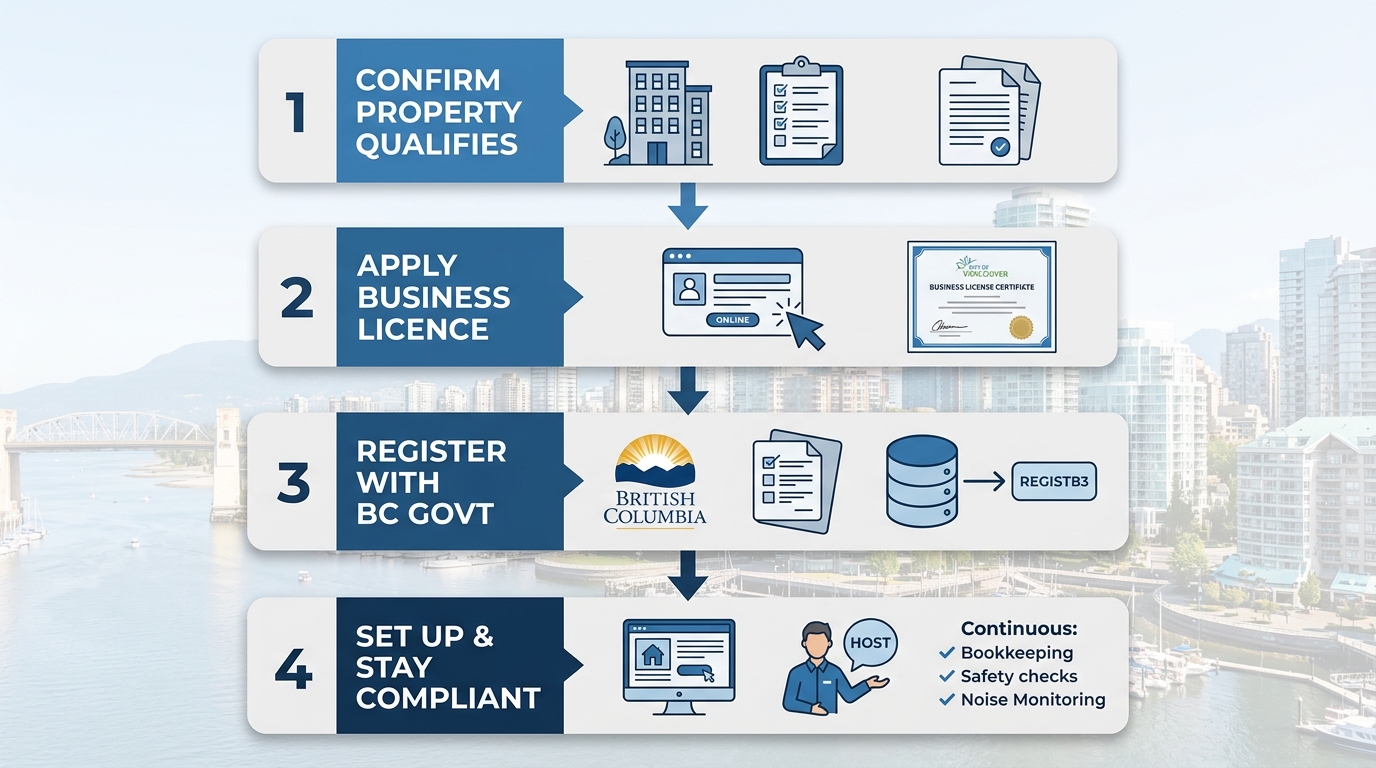
Four-step process to launch a Vancouver short-term rental
Step 3: Register with the BC Government
After you receive your municipal business licence, you must register with the BC Short-Term Rental Registry. According to the Government of British Columbia, this registration helps hosts avoid provincial penalties. The registry number must be displayed on all of your listings, including Airbnb and direct booking channels.
Step 4: Set Up Your Rental and Stay Compliant
Once the legal steps are complete, prepare your short-term rental in Vancouver for guests. We advise setting up a guest screening process, using clear rental agreements, and securing adequate insurance coverage. For expert guidance on listing optimization and direct booking strategies, explore our rental property management Vancouver page. Please note that Georgia Properties provides consulting and marketing support only–we do not manage or operate properties, and outcomes depend on market conditions and your execution. This material is not legal advice; consult a licensed professional for legal or tax questions.
Your Path to Vancouver Short-Term Rental Compliance
Navigating short term rental regulations in Vancouver starts with understanding the requirements set by the Government of British Columbia. Hosts must obtain a short term rental business licence in Vancouver, provide their principal residence address (meaning the host resides in the unit), and comply with local zoning bylaws. Official details are available on the BC government website for verification. Compliance is an ongoing responsibility; licences need renewal and regulations evolve. We guide hosts through each compliance step, but always verify official requirements and consult licensed professionals for legal or tax advice. Explore our Vancouver rental property management compliance consulting for step-by-step guidance.